Climate Impulse logo (white version)
Latest

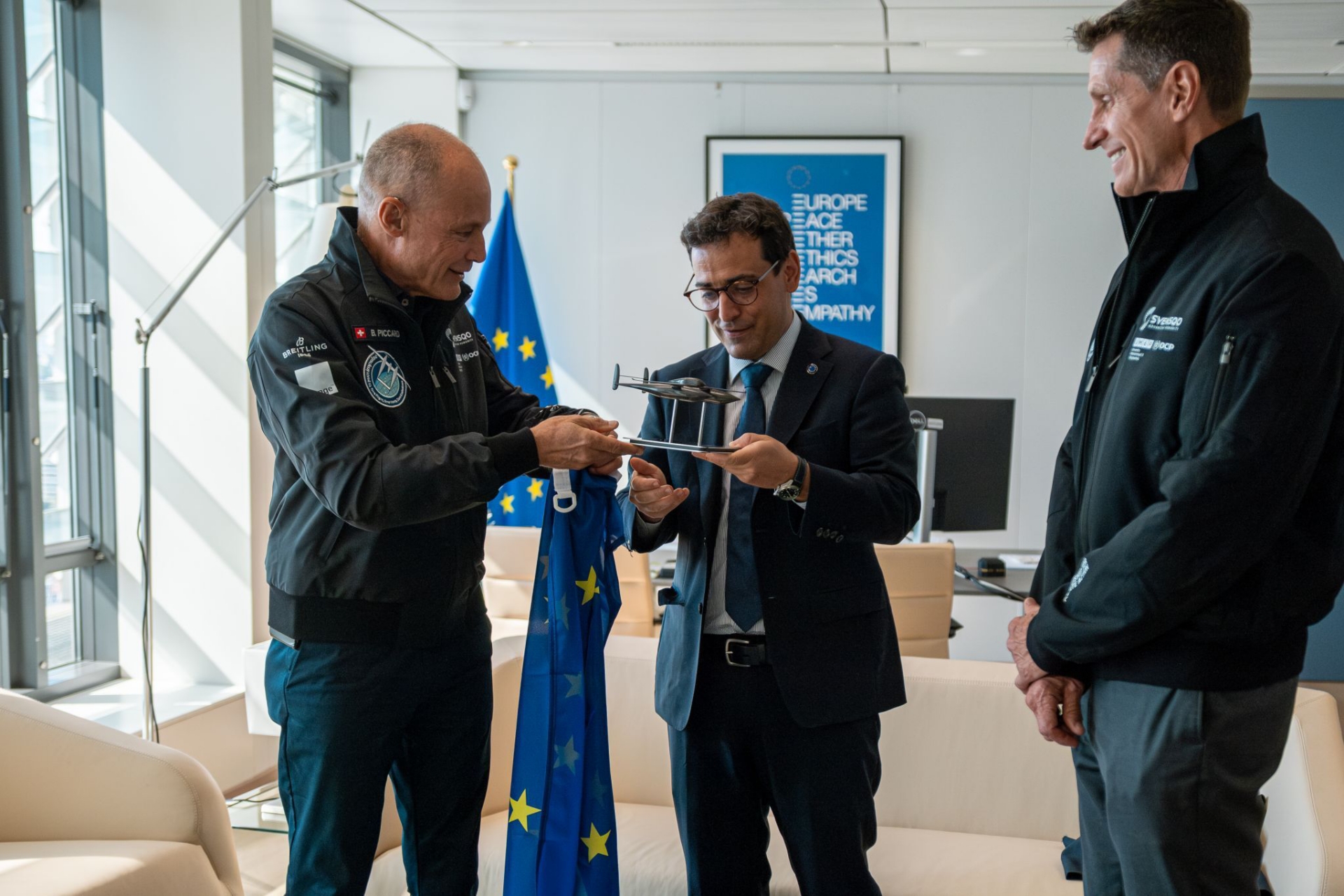
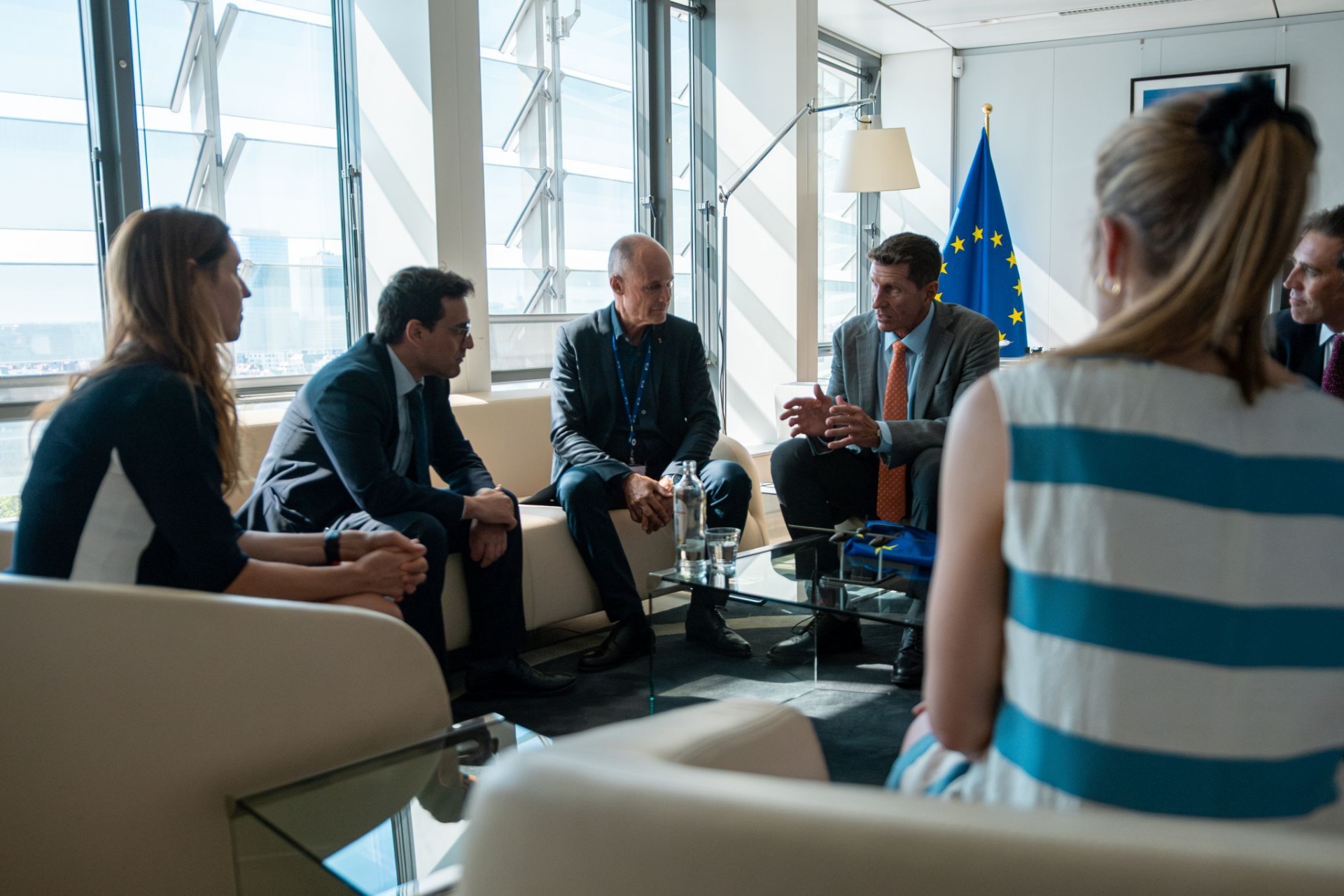
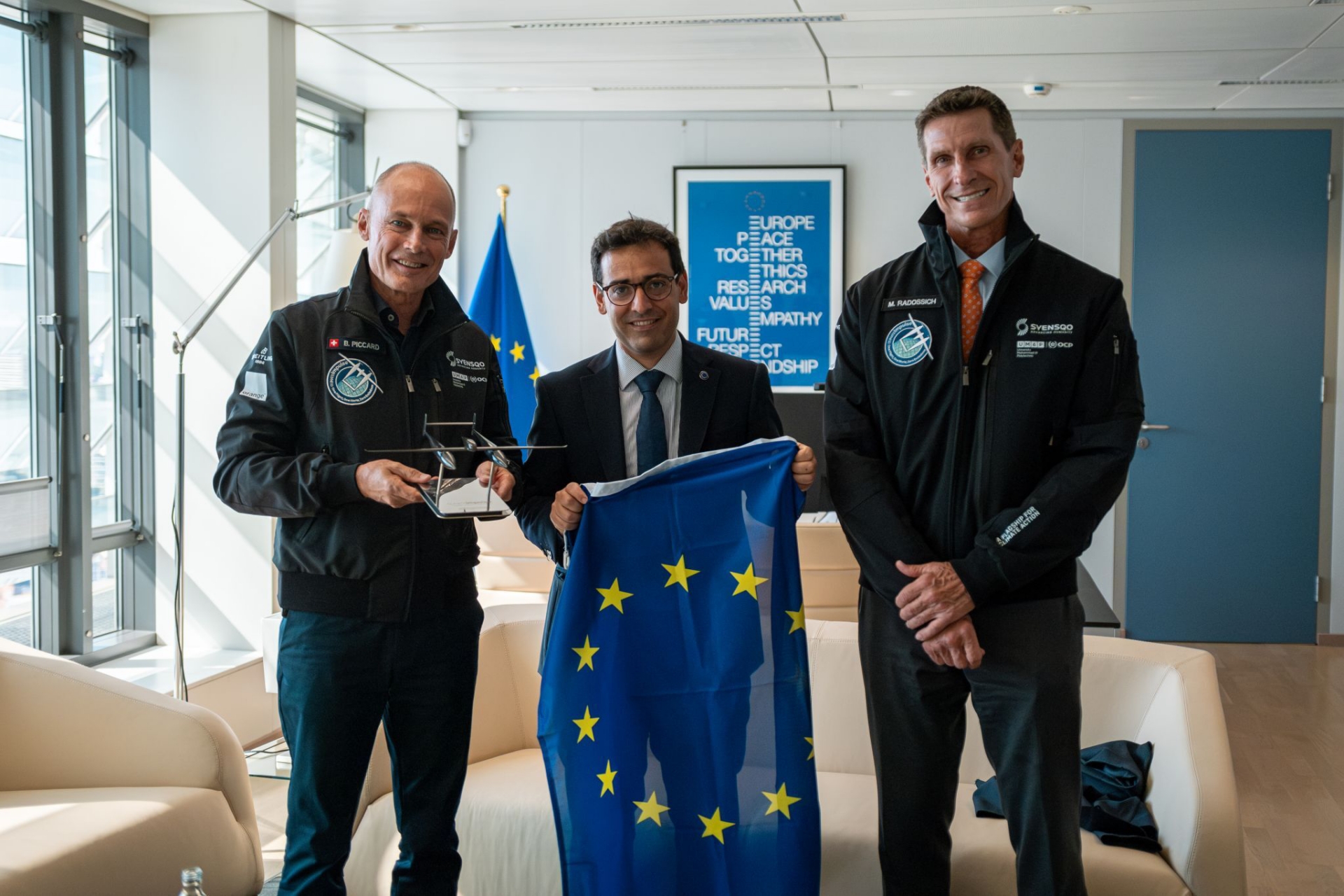
Brussels, Belgium – July 2026 — The European Commission has granted its official patronage to Climate Impulse, recognising the project's alignment with Europe's climate, innovation and sovereignty agenda. Stéphane Séjourné, Executive Vice-President of the European Commission, hailed the project as a testament to European ingenuity, while Bertrand Piccard welcomed the endorsement as a signal of Europe's confidence in innovation as a driving force for sustainable growth and environmental progress.
Scientific adventure

Our Guiding Vision:
a clean and efficient world

This historical flight planned in 2030 aims to be a flagship for climate action, showcasing how efficient solutions can set the world on a sustainable course. The inspiring journey will only be made possible through a shared vision and the power of cooperation, each team member, each man and woman, from the engineers to the meteorologists and the mechanics bringing their own experiences of innovation, pioneering spirit and putting their certitudes into question to power a great trailblazing adventure.

“Efficient solutions will unite people, from citizens and environmental activists to political and business leaders, shifting the narrative from sacrifice and fear to enthusiasm and hope.”

Bertrand Piccard

Shadow of Climate Impulse over the farming fields, aerial view
Exploration
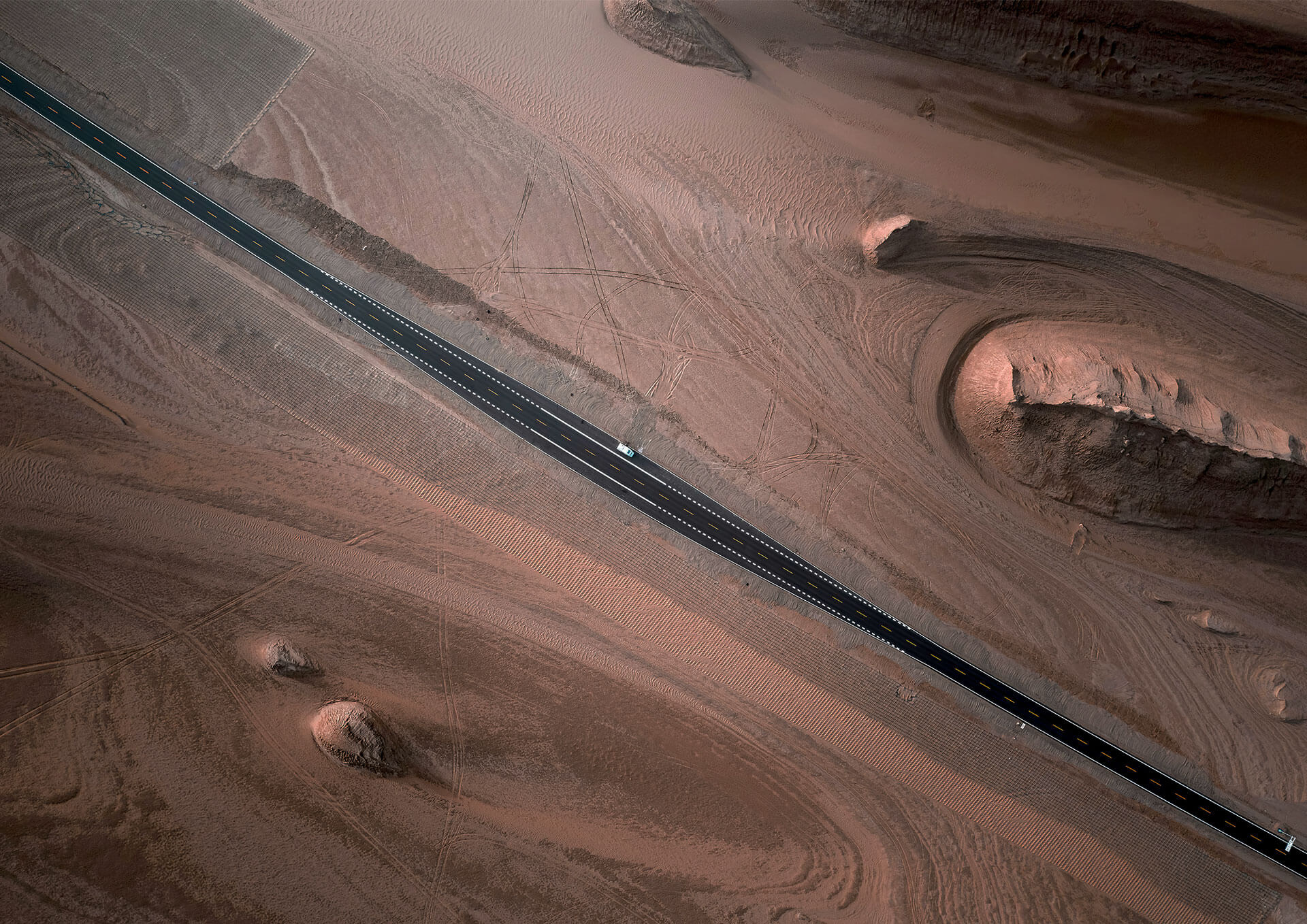
Aerial view of a road in the desert

The success of this project will pave the way for sustainable and more responsible aviation mobility.

“More than flying around the world with a hydrogen airplane, Climate Impulse will explore new ways of thinking and acting to promote a better quality of life.”

Bertrand Piccard

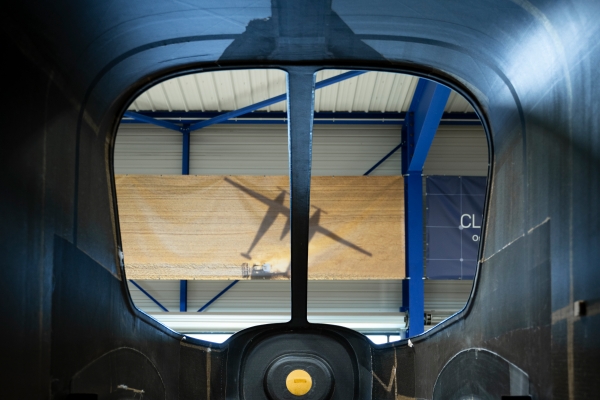
“The major technological challenge is to build an aircraft around two liquid hydrogen tanks maintained at -253°C, powering electric motors through fuel cells.”

Raphael Dinelli

Pilots & Team

World Tour

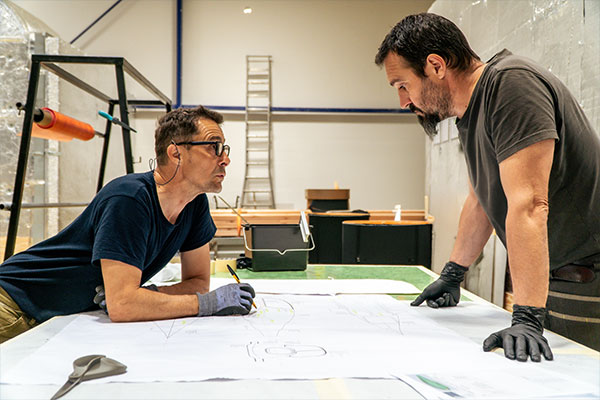
Bertrand Piccard and Raphaël Dinelli are teaming up to demonstrate that solutions can effectively lift our world towards a more sustainable future.
Timeline
Partners

Main Partner

syensqo logo (black version)syensqo logo (original color version)
um6p-ocp logo (black version)um6p-ocp logo (original color version)

Official Partner

breitling logo (black version)breitling logo (original color version)
orange logo (black version)orange logo (original color version)

Mission Supporters

Airbus Foundation, Axa, Bouygues, BNP Paribas, Schneider Electric Foundation, Région Grand Est, ADEO, Région Île de France

Mission supporters are reserved for partners of the Solar Impulse Foundation

Collective intelligence

Climate Impulse brings together audacious partners united by a common dedication to innovation for sustainability.
Shadow of Climate Impulse over the ocean, aerial view
Sponsorship level
  • Main Partner
  • Official Partner
  • Official Supporter
  • Service Supplier
  • Specialized Partner
  • Mission Supporter

For additional information on the Climate Impulse Partnership Offering

Contact
News & Press
Article

News | November 23, 2026

Electrification: Not as good as Better!

COP31 is in full swing in Antalya. Among the hot topics commanding attention is electrification, with the Turkish presidency hoping to raise the share of electricity in final energy consumption from just over 20% today to 35% by 2035.But how to get there is a matter of debate.On one side are those who believe electrification only makes sense if the electricity comes from decarbonized sources.On the other is a less ambitious camp: let's electrify transport and heating right now, even when the electricity is still produced from fossil fuels.Their argument?An electric motor uses energy far more efficiently than a combustion engine. A heat pump can deliver three to five times more useful heat than a gas boiler for the same energy consumption, regardless of the source powering the machines. These are the laws of physics.In many countries, from Poland to South Africa, from India to China, the electricity mix is still largely fossil-based. Even in these contexts, electrification would already reduce energy waste, despite the losses involved in generating electricity in thermal power plants. An electric car can become cleaner over the years, as the electricity powering it decarbonizes. A combustion-engine car, on the other hand, will remain dependent on its fuel.Not all electrification is equal, then. Electrification that still relies on fossil fuels is a first step; electrification based on clean electricity lets us take a second.What is interesting is that electrification is becoming a unifying issue, a possible common ground between countries on different energy trajectories. Even the major producers or users of fossil fuels will benefit from the efficiency gains that electrification brings. For countries accelerating decarbonization, it is an additional lever for reducing emissions. The motivations differ, but the interests converge.In any case, the course must remain the same: gradually (but as fast as possible) phase out fossil fuels.Electrification must not be used as a pretext to prolong our dependence on these fuels. Nor should it obscure a major inconsistency: we are mobilizing considerable sums to finance the energy transition, while spending nearly one trillion dollars a year (in Europe, nearly 100 billion in 2024, according to the IEA) to subsidize and support the system we are seeking to leave behind. We are thus simultaneously financing both the transition and the obstacles to its success.Even if COP31 sidesteps the question of phasing out fossil fuels, electrification can build consensus. To address it, let's change the nature of the debate: rather than pitting fossil fuels against climate imperatives, let's highlight the competitiveness of electrification through renewables, the untapped potential of geothermal energy and the considerable savings offered by energy efficiency, not forgetting nuclear power, which is making a strong comeback. By making the alternatives economically irresistible, we will make fossil fuels progressively obsolete.For that is the lesson of electrification: its economic benefits no longer need to be proven. So if some are not waiting for electricity to be clean before electrifying, let us not wait until we have electrified before decarbonizing!

Article

News | November 3, 2026

Climate is not one issue among others on the table: it is the table itself

As wars, technological rivalries, trade tensions and political polarisation fuel a retreat into isolation, the COPs remain one of the few constants of international cooperation. The 31st edition opens in Türkiye.This continuity is far from trivial. It reminds us that behind the crises dominating the headlines, an even deeper drama is unfolding. Climate is not just another item on the table. It is the table itself! Because behind the climate question lie the questions of energy, of the resources that power our economies, and of the conditions that may (or may not) allow humanity to remain on this planet. Nothing less.What is at stake, then, is our model. How can we enable billions of people to reach a legitimate level of prosperity, and others to preserve theirs, while respecting planetary boundaries?In my view, this is not about giving up on development. It is about breaking with an economic model based on quantity, where creating wealth always demands more energy and raw materials. True progress means replacing what pollutes and wastes with what protects the environment and builds an economy of efficiency: doing better with less, so we can move to a qualitative economy, a third way between unrealistic degrowth and unlimited growth that leads to ecological disaster.COP31's goals for 2035 are therefore commendable: raising the share of electricity in final energy consumption from 20% to 35%, and cutting the energy intensity of buildings by 25%.Countless profitable solutions for businesses and consumers already exist to get there, in every sector (more than 2,000 identified so far by the Solar Impulse Foundation!). The challenge is no longer so much to invent as to deploy, at scale, what we have already invented.Yet a solution can be technically available, economically profitable and ecologically essential, and still not be adopted. This is a paradox that COP31 must help resolve.Having worked daily with these solution providers for the past 10 years, I see three obstacles: polluting habits that are still profitable, a narrative that frames the transition as a sacrifice rather than a benefit, and the need for upfront investment that slows the adoption of solutions.The first can only be addressed through appropriate rules that reflect strong political commitments. That is the spirit of the roadmap for transitioning away from fossil fuels announced at COP28 in Dubai. This obstacle is probably the most formidable: favouring clean solutions and turning ecological modernisation into a competitive advantage requires a form of global governance, which is the very reason the COPs exist.The second is in our minds. As long as the transition is told as a series of sacrifices, it will meet more resistance than support. To bring economic, political and social actors on board, let us instead show its many benefits: lower costs, sovereignty, jobs, competitiveness and quality of life.As for the last obstacle, the financial one: why require businesses or individuals to invest first in order to save later, when energy performance contracts, in the form of servitisation, can let them save from day one? This is the kind of economic revolution now under way, and COP31 must accelerate it.Not all of these questions will be resolved in Antalya between 9 and 20 November. But the fact that the challenge is immense is no reason to give up on meeting it.

Article

News | July 23, 2026

Carbon and long-haul flights: Europe must not miss its boarding call

An aircraft doesn't take off by abolishing gravity. It takes off by mastering it. The same is true of the ETS, Europe's carbon-credit system. You can see it as an extra weight loaded onto air transport. Or as the force that compels an entire industry to become more efficient.This July, the European Commission is expected to unveil its proposal on the mechanism's future. Bringing long-haul flights — until now exempt from the ETS — into its scope divides the aviation community, between defenders of the status quo and players, often newer ones, calling for a strong signal in favour of decarbonising the sector.We are at a fork in the road; two trajectories lie ahead of us. Let us gain some altitude to examine them.If air transport as a whole now falls under the ETS, airlines will have no choice but to hunt down every source of waste. Every kilo of fuel saved will count twice: it will cut not only their energy bill, but also the number of carbon allowances they have to buy. The room for improvement is immense, because the solutions already exist: optimising consumption with tools like SkyBreathe, towing aircraft to the runway with electric tugs, plugging planes into airports' electrical grid rather than running their auxiliary engines, avoiding absurd detours, making continuous-descent approaches standard, speeding up fleet renewal with the most fuel-efficient aircraft… Millions of litres of fuel are already saved this way; the ETS gives them the economic value they lacked to become the norm. Carbon stops being merely a cost: it becomes one more reason to invest in intelligence.Conversely, keeping long-haul flights outside the ETS would offer immediate relief, but would above all risk postponing the transformations we cannot do without. Airlines would remain dependent on a variable they don't control: the price and availability of oil. They would keep enduring its swings to feed a model of the past, instead of regaining control of their costs in order to invest in competitiveness.History shows that innovation changes the world when it becomes more advantageous than the status quo. That is precisely the role of well-designed rules of the game. A significant share of the revenues (estimated at nearly €9 billion a year) should therefore be reinvested in the aviation sector, in order to accelerate the very innovations it seeks to encourage — in particular sustainable fuels (for tomorrow) and green hydrogen (for the day after). A public policy is effective when it turns a constraint into a capacity to act.So yes, long-haul tickets will probably cost more during this transition, but they would remain infinitely cheaper than they were two or three decades ago. That added cost also tells a truth long kept hidden: the price of a flight has never reflected its climate cost. This signal will lead us to question the necessity of certain journeys and the value we place on each trip — and, above all, it will finance the emergence of clean aviation. Like any great industrial transformation, the transition has a price. The illusion would be to believe that standing still has none!The future of aviation will not depend on our ability to fly less — desirable, no doubt, but unrealistic given the aspirations of emerging countries in this field. It will depend on our ability to fly infinitely better.The challenge is not to choose between flying and protecting the climate. It is to ensure that one finally makes the other possible.First published by Le Temps and La Tribune.